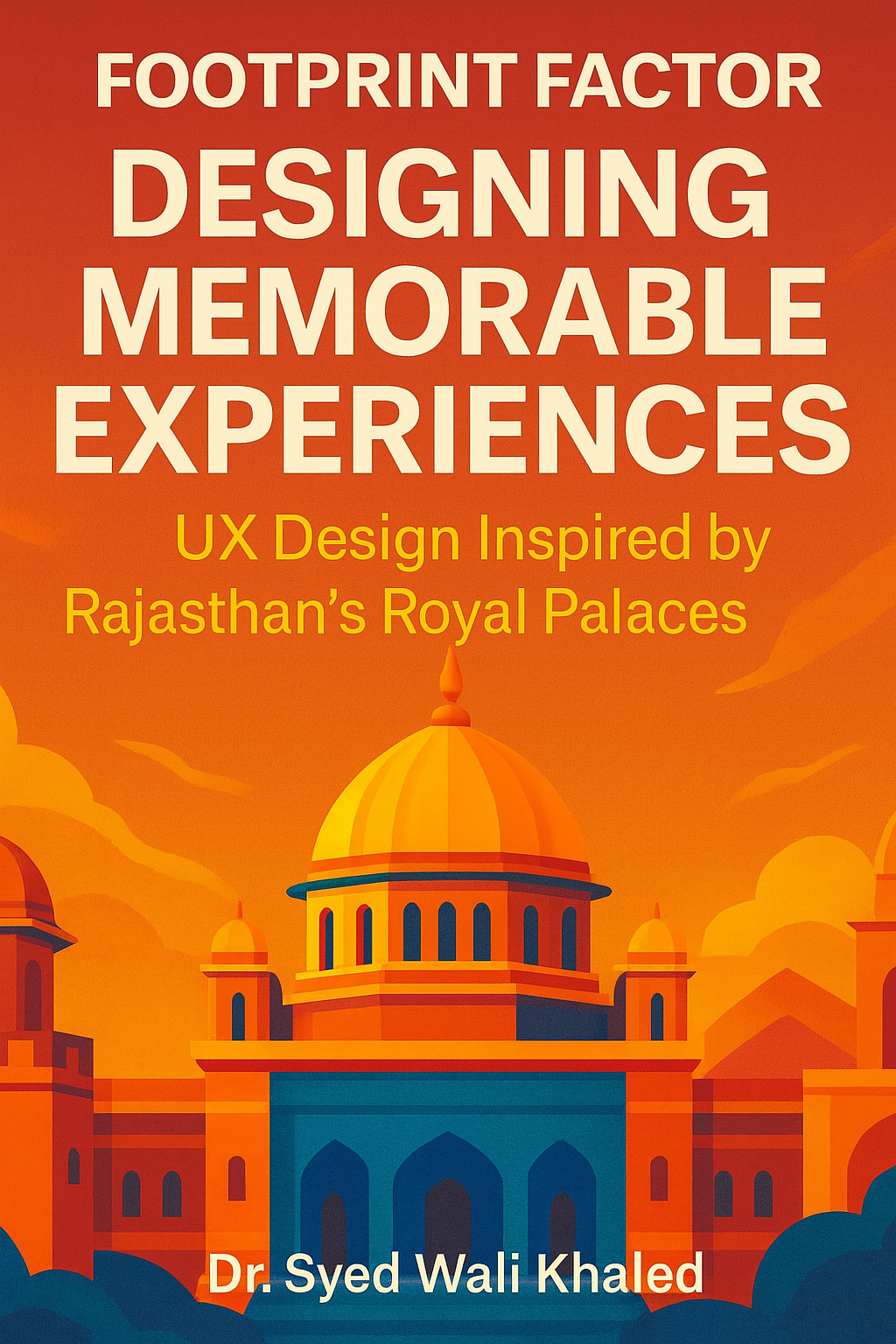
Footprint Factor: Designing Memorable Experiences – Lessons from Rajasthan’s Heritage Palaces for UX Designers
by Dr. Syed Wali Khaled
Rajasthan’s heritage palaces, such as the iconic Umaid Bhawan Palace, are not merely architectural masterpieces but immersive experiences that captivate guests through sensory delight, authenticity, and emotional resonance. These centuries-old hospitality practices offer valuable lessons for modern UX design, particularly in the realm of sensory experience design. By analyzing how these palaces create unforgettable guest journeys, UX designers can draw inspiration to craft digital products that forge lasting emotional connections with users. This article explores five key lessons—authenticity, sensory engagement, personalization, creating memories, and emotional connection—and illustrates their application through real-world UX case studies, supported by academic research on sensory design principles. For a deeper dive into sensory design, explore this insightful article: Sensory Design: Crafting Immersive Digital Experiences Through the Senses.
Key Lessons in Experience Design
The design principles of Rajasthan’s heritage palaces align closely with sensory UX design, offering a framework for creating engaging digital experiences. The following table outlines these lessons, their manifestations in palace design, and their applications in UX:
|
Lesson
|
Heritage Palace Example
|
UX Application
|
|
Authenticity
|
Maintains historical integrity with modern comforts, blending Rajput and Mughal styles with contemporary amenities.
|
Design transparent, honest interfaces that align with brand values and user expectations, avoiding manipulative patterns like dark UX.
|
|
Sensory Engagement
|
Engages sight (ornate architecture), taste (royal cuisine), touch (luxurious furnishings), and sound (traditional music).
|
Use high-resolution visuals, audio cues, and haptic feedback to create immersive digital experiences.
|
|
Personalization
|
Tailored services for each guest, such as customized dining or guided tours.
|
Deliver customized content, like tailored recommendations, using user data while prioritizing privacy.
|
|
Creating Memories
|
Unique experiences, like royal dining in opulent settings, leave lasting impressions.
|
Design delightful micro-interactions, animations, or Easter eggs that users remember.
|
|
Emotional Connection
|
Stories of royal lineage and cultural heritage foster empathy and connection.
|
Integrate storytelling into onboarding and branding to humanize the product and resonate emotionally with users.
|
Why It Works
Heritage palaces like Umaid Bhawan captivate guests with rich, multi-sensory experiences—vibrant Art Deco architecture, the taste of centuries-old royal recipes, the tactile luxury of handwoven upholstery, and the sounds of traditional Rajasthani music. These elements mirror sensory UX design, which leverages sight, sound, and touch to enhance navigation, discoverability, and emotional engagement. Research suggests that engaging multiple senses strengthens emotional ties and improves brand recall, making experiences more intuitive and memorable (Santangelo & Macaluso, 2015). For instance, the use of regal colors and intricate stonework in palaces creates a visually stimulating environment, akin to how vibrant visuals and animations enhance digital interfaces.
Practical UX Strategies Inspired by Palatial Design
To create captivating digital experiences, UX designers can adopt strategies inspired by Rajasthan’s palaces:
-
Visual Design: Use color psychology—blue for calm, orange for excitement—to evoke emotions, paired with high-quality graphics and animations.
-
Sound Design: Incorporate subtle audio cues, such as notification sounds or button-click feedback, to guide user actions and enhance immersion.
-
Touch Feedback: Implement haptic feedback in mobile interactions for tactile engagement, mimicking the tactile richness of palace furnishings.
-
Personalization: Leverage behavioral data to tailor experiences, ensuring compliance with privacy regulations like GDPR.
-
Memory Makers: Add branded animations or micro-moments of delight, such as interactive transitions, to create memorable interactions.
Deep Dive: Lessons Explained with UX Examples
Lesson 1: Authenticity
-
Palace Insight: Palaces like Umaid Bhawan blend historical Rajput and Mughal architectural styles with modern comforts, maintaining cultural integrity while meeting guest expectations.
-
UX Application: Design interfaces that are transparent and trustworthy, delivering on brand promises without resorting to manipulative tactics like dark patterns. For example, Apple’s clean, minimalist interfaces reflect its brand ethos of simplicity and innovation, fostering trust through consistency.
-
Academic Insight: Authenticity in design ensures that users perceive the product as genuine, aligning with principles that emphasize expressing the true qualities of materials or experiences without deception (Hoober, 2016).
Lesson 2: Sensory Engagement
-
Palace Insight: Palaces engage multiple senses through ornate architecture (sight), royal cuisine (taste), luxurious furnishings (touch), and traditional music (sound).
-
UX Application: Combine high-resolution visuals, satisfying animations, and tactile feedback to create immersive experiences. For instance, Starbucks’ mobile app uses warm colors, smooth animations, and subtle sounds to evoke the cozy ambiance of its stores.
-
Academic Insight: Research shows that recall is better for cross-modal (audiovisual) objects compared to modality-specific objects, and working memory capacity increases with multisensory stimuli (Santangelo & Macaluso, 2015). This suggests that integrating multiple sensory inputs in UX design can enhance user engagement and retention.
Lesson 3: Personalization
-
Palace Insight: Services are tailored to guest preferences, such as personalized dining experiences or curated tours.
-
UX Application: Personalization enhances user engagement and trust through tailored experiences. For example, Airbnb’s platform suggests listings based on user preferences, increasing relevance and engagement.
-
Academic Insight: AI-driven personalization can analyze user data to provide customized content, but ethical considerations like privacy and inclusivity are crucial. Research highlights that personalization improves engagement but requires transparency and user consent to avoid bias and exclusion (Seyedan & Mafakheri, 2020).
Lesson 4: Creating Memories
-
Palace Insight: Unique experiences, like royal dining in opulent settings, leave lasting impressions.
-
UX Application: Design delightful micro-interactions, animations, or Easter eggs that users remember. For example, Apple’s MacBook Pro touch bar adapts to applications, providing tactile feedback that creates memorable interactions.
-
Academic Insight: Studies show a strong relationship between sensory stimulation and positive memory, with sensory-rich experiences enhancing memory formation by engaging cognitive and emotional processes (Månsson et al., 2021).
Lesson 5: Emotional Connection
-
Palace Insight: Stories of royal lineage and cultural heritage foster empathy and connection.
-
UX Application: Integrate storytelling into onboarding and branding to humanize the product and resonate emotionally with users. For instance, Airbnb’s use of host stories in its interface fosters emotional connections with users.
-
Academic Insight: Storytelling in design bridges analysis and synthesis, fostering empathy by imagining user journeys. This process helps designers create emotionally resonant designs that connect with users’ motivations and desires (Parrish, 2006).
Case Studies: Sensory UX in Action
-
Starbucks:
-
Sensory Elements: The mobile app uses warm colors, smooth animations, and subtle sounds to evoke the in-store experience.
-
Impact: Enhances user satisfaction and engagement by creating a cohesive sensory journey.
-
Academic Insight: Multisensory design improves recall and emotional connection, aligning with research on cross-modal stimuli (Santangelo & Macaluso, 2015).
-
Apple:
-
Sensory Elements: The MacBook Pro’s touch bar provides adaptive, tactile feedback.
-
Impact: Creates immersive, memorable interactions by engaging multiple senses.
-
Academic Insight: Sensory-rich experiences enhance memory formation, supporting user retention (Månsson et al., 2021).
-
Airbnb:
-
Sensory Elements: Descriptive imagery and text evoke sensory memories, such as the ambiance of a beach house.
-
Impact: Fosters emotional connections through storytelling and personalized recommendations.
-
Academic Insight: Storytelling fosters empathy, enhancing user engagement through narrative-driven design (Parrish, 2006).
Tips for Success in Sensory UX Design
-
Know Your Users: Conduct user research to tailor sensory engagement to preferences, ensuring relevance and impact.
-
Design Inclusively: Test sensory elements for accessibility, providing alternatives for visually or hearing-impaired users.
-
Avoid Overload: Balance sensory inputs to enhance experiences without overwhelming users, as excessive stimuli can detract from usability (Santangelo & Macaluso, 2015).
Final Takeaway
“When you design for the senses, you stay in people’s memories.” The lesson from Rajasthan’s heritage palaces is clear: engaging multiple senses creates immersive, emotionally resonant experiences. By integrating authenticity, sensory engagement, personalization, memory creation, and emotional connection, UX designers can craft digital products that not only meet functional needs but also leave lasting impressions, much like a stay in a royal palace. For further insights, explore this article on sensory design: Sensory Design: Crafting Immersive Digital Experiences Through the Senses.
References
Hoober, S. (2016). Flatly authentic. UXmatters. https://www.uxmatters.com/mt/archives/2016/07/flatly-authentic.php
Månsson, J., Sundman, M., & Bjällmark, A. (2021). Creating positive memory in staged experiences through sensory tools. Current Issues in Tourism, 24(22), 3157–3172. https://doi.org/10.1080/13683500.2021.1952943
Parrish, P. (2006). Design as storytelling. TechTrends, 50(4), 72–82. https://doi.org/10.1007/s11528-006-7591-6
Santangelo, V., & Macaluso, E. (2015). A multisensory perspective of working memory. Frontiers in Psychology, 6, 440. https://doi.org/10.3389/fpsyg.2015.00440
Seyedan, F., & Mafakheri, F. (2020). The impact of AI-driven personalization on UX/UI design: Navigating ethical considerations and data-driven practices. Revista de Tecnologia e Sociedade, 16(42), 123–135. https://revistaft.com.br/the-impact-of-ai-driven-personalization-on-ux-ui-design-navigating-ethical-considerations-and-data-driven-practices/